Free Online Game
Daily Addition Practice for Kids: Fun Ways to Practise Math
Daily addition practice for kids works best when it is regular, varied, and matched to what a child currently understands. It does not need to mean a long page of sums every day. Mental maths, number cards, everyday objects, short written activities, and browser-based addition games can all provide useful practice.
The main goal is to help children become more comfortable with numbers and addition strategies. Accuracy and understanding should come first. Speed can be introduced gradually when a child is confident with the calculations.
What Is Daily Addition Practice for Kids?
Daily addition practice simply means giving children regular opportunities to work with addition. The questions and activities should suit their current level rather than following one fixed format.
A child beginning addition might work with small quantities and sums such as 2 + 3 or 4 + 1. Someone who already knows many basic facts may practise combinations that make 10, doubles, two-digit addition, or mental calculation strategies.
Good practice also involves more than memorising answers. Children benefit from understanding what addition represents: combining quantities to find a total. This is why practical objects, visual representations, spoken questions, written calculations, and games can complement one another.
The same calculation can even be approached in several ways. For 8 + 7, for example, one child may count on from 8, while another may make 10 by thinking of 8 + 2 + 5. Exploring these approaches can help children become more flexible with numbers.
BIO
| Label | Information |
|---|---|
| Topic | Daily addition practice for kids |
| Main purpose | Regular practice with addition facts and calculations |
| Suitable audience | Children learning or practising basic addition |
| Practice format | Mental math, written sums, objects, cards, and games |
| Starting point | Simple sums matched to the child’s current ability |
| Key skills | Addition facts, number recognition, and mental calculation |
| Useful strategies | Making 10, doubles, near doubles, and breaking apart numbers |
| Practice pace | Focus on understanding and accuracy before speed |
| Timed practice | Optional once the relevant addition skills are familiar |
| Difficulty | Can progress gradually from small sums to larger numbers |
| Online practice | Browser-based addition games can add variety |
| Related activities | Subtraction, number typing, and other mental math exercises |
| Important limitation | Game scores should not be treated as measures of intelligence or ability |
Why Short Addition Practice Can Be Useful
Repeated opportunities to work with numbers can help children become more familiar with addition facts and calculation methods. However, repetition is most useful when children also understand the mathematics behind the answers.
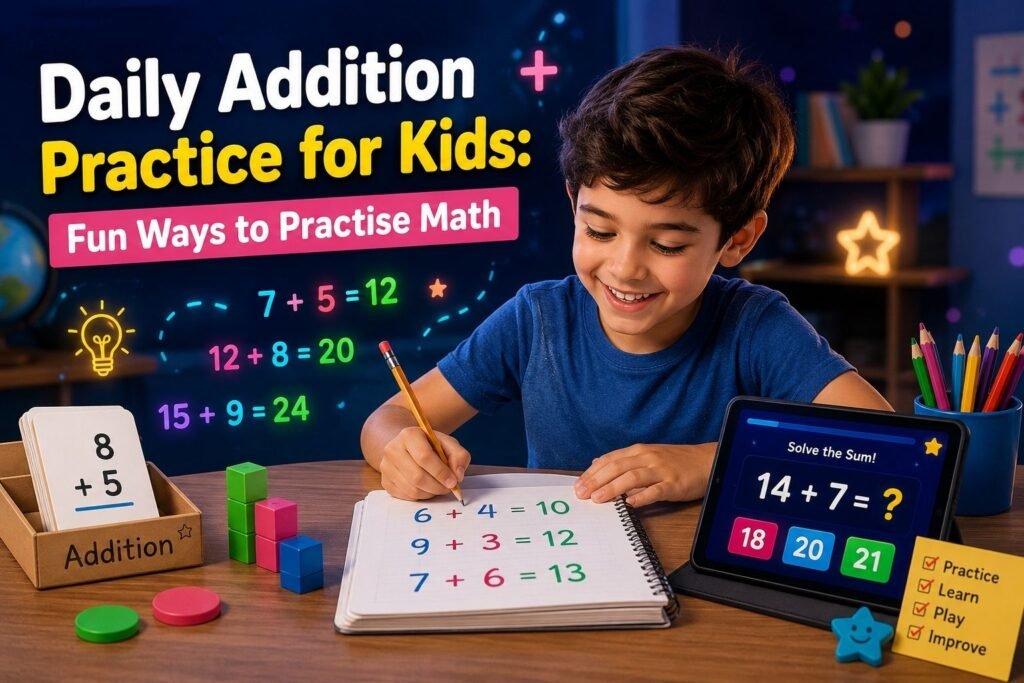
Consider 6 + 4. A child might count six objects and then another four objects before counting the complete group. With experience, the child may recognise that 6 and 4 make 10 without needing to count each object individually.
That growing familiarity can make later calculations easier to handle. A familiar fact such as 6 + 4 = 10 can become a useful building block for solving related problems.
Daily practice can include opportunities to work on:
- Number recognition
- Addition facts
- Mental calculation
- Number bonds
- Place value
- Careful answer entry
- Different calculation strategies
There is no need to turn every activity into a race. A child who can explain how an answer was found may be getting more useful practice than one who simply guesses quickly.
How to Start a Daily Addition Routine
A useful routine begins at an appropriate difficulty. If a child is still working out 4 + 3 using objects or fingers, immediately introducing complicated two-digit mental addition is unlikely to make the session more productive.
Begin with calculations the child can engage with, then add manageable challenges.
A simple session might start with a few familiar facts, continue with one new or less familiar type of problem, and finish with an enjoyable activity.
There is no universal session length that is right for every child. Age, experience, schoolwork, difficulty, interest, and concentration all matter. Quality is more useful than stretching practice simply to make it longer.
Variety can also prevent a routine from becoming repetitive. Instead of using a worksheet every day, rotate between verbal questions, number cards, physical objects, written sums, and maths games.
Fun Ways to Practise Addition Every Day
Addition can appear naturally in activities that feel different from conventional written exercises.
Quick Mental Addition
Ask a small number of questions aloud and let the child calculate mentally.
Start with familiar sums such as:
5 + 3
7 + 2
6 + 4
8 + 5
Rather than immediately saying whether an answer is right or wrong, occasionally ask, “How did you work that out?”
The explanation can reveal the strategy being used. A child answering 8 + 5 might count on five steps, make 10 first, or use another known fact.
Use Everyday Objects
Small physical objects can make addition visible.
Place four blocks on a table and add three more. Ask how many there are altogether. The child can physically combine the groups and connect the quantity with the written calculation 4 + 3 = 7.
Counters, pencils, toy pieces, buttons used under suitable supervision, or other safe objects can serve the same purpose.
The important part is connecting the objects to the mathematical idea. Moving two groups together should relate clearly to the numbers and addition symbol being discussed.
Try Number Cards
Create or use cards containing digits. Pick two cards and add the values.
The activity can be adapted easily. Younger children can use smaller digits, while children ready for more challenge can create two-digit numbers or look specifically for pairs that make a target total.
A “make 10” activity is particularly simple. Show one number and ask what needs to be added to reach 10.
For example:
1 + ? = 10
6 + ? = 10
8 + ? = 10
Once these combinations become familiar, they can support other mental addition strategies.
Add a Speed Challenge
Timed activities can provide variety when a child already understands the sums being presented.
An online addition speed test might show one calculation at a time and ask the player to enter the answer before a timer finishes. Scores and levels can turn familiar addition into a personal challenge.
The key is to use timing appropriately. A timer should not replace learning how addition works.
If a child is making many errors because of the clock, return to untimed practice. Once the calculations feel manageable, a timed game can be tried again.
Addition Strategies Kids Can Practise
Efficient mental addition is not just about thinking faster. Useful number relationships can make a calculation simpler.
Making 10
Making 10 can help with sums that cross 10.
Take:
8 + 7
The 8 needs 2 to become 10. Split 7 into 2 and 5:
8 + 2 = 10
10 + 5 = 15
Therefore, 8 + 7 = 15.
Using counters or a ten-frame can make this relationship easier to see before expecting a child to perform it entirely mentally.
Doubles and Near Doubles
Known doubles can provide another useful starting point.
If a child knows:
7 + 7 = 14
then 7 + 8 can be considered as one more:
14 + 1 = 15
Likewise, knowing 6 + 6 may help with 6 + 7.
The aim is not to force one method onto every calculation. Children can learn to recognise when a familiar fact makes another problem easier.
Breaking Numbers Apart
Larger numbers can often be separated according to place value.
For example:
24 + 13
can be considered as:
20 + 10 = 30
4 + 3 = 7
30 + 7 = 37
Another child might begin at 24, add 10 to reach 34, and then add 3.
Both approaches can reach the same answer. Comparing methods can help children understand that there may be more than one sensible way to calculate.
A Simple Daily Addition Practice Plan
A daily routine does not need complicated preparation.
Begin with a few familiar calculations as a warm-up. These can include known number bonds, doubles, or simple facts from recent practice.
Next, introduce a small number of questions at the child’s current working level. If a particular combination causes difficulty, explore it rather than simply repeating the answer.
Then change the format. Use objects, number cards, a verbal challenge, or a browser-based addition game.
For example, a session could look like this:
Warm-up: familiar addition facts.
Main practice: a small selection of current-level sums.
Strategy practice: explore making 10, doubles, or breaking apart numbers.
Fun activity: play a short addition game or card challenge.
Finish: use one or two manageable questions to check understanding.
This structure can be adjusted freely. Some days may involve only mental maths, while others may focus on practical objects or games.
How to Keep Addition Practice Fun
Children do not necessarily need a completely new activity every day. Small changes can make familiar practice feel less repetitive.
Let the child choose between two suitable activities occasionally. One option might be number cards and another an online maths game.
Personal challenges can also work well. Instead of comparing one child with classmates or siblings, focus on their own previous work. In a game, that might mean trying to answer more carefully or reaching a new level.
Praise should not be limited to fast answers. A careful strategy, corrected mistake, or clear explanation can also be worth recognising.
Difficulty matters too. Practice that is consistently far below a child’s level may become dull, while work that is far beyond current understanding can become frustrating. Adjust the numbers as the child’s confidence and knowledge develop.
Common Practice Mistakes
One common mistake is treating speed as the main goal from the beginning. Fast answers are less useful if the child is guessing or does not understand why an answer is correct.
Another is using only one practice format. Repeating similar worksheets may provide practice, but children can also encounter addition through objects, conversation, games, number representations, and everyday situations.
Be careful about increasing difficulty too quickly. Knowing a few simple facts does not automatically mean a child is ready to perform larger calculations mentally.
It is also worth avoiding unnecessary comparisons. Children develop mathematical knowledge at different rates and bring different experiences to practice.
Finally, games should be part of a broader approach rather than the only way addition is encountered. Interactive activities can make repetition engaging, while discussion and practical examples can help reveal how the mathematics works.
Tracking Progress Without Pressure
Progress does not have to be represented by one score.
Notice whether previously difficult facts are becoming more familiar. Listen to how the child explains a calculation. Look for changes in strategy, such as moving from counting every item to using known number relationships.
A simple note of troublesome facts can guide future sessions. If 8 + 7 repeatedly causes difficulty, revisit making 10 or use counters to represent the calculation.
Game results can also provide a personal practice marker, but conditions matter. A score may vary with the difficulty of the questions, the device being used, typing or tapping speed, interruptions, and familiarity with the game.
For that reason, a game score should not be treated as a complete assessment of mathematical ability.
Using Online Addition Games
Browser-based maths games can add a different kind of activity to daily addition practice for kids.
A game that presents one problem at a time can keep the screen focused on the current calculation. Timers, levels, lives, and personal scores can add challenge for children who enjoy that format.
Desktop and mobile play can feel different. A physical keyboard may allow faster number entry, while a phone or tablet relies more heavily on touch controls. This can affect a timed score even when the mathematical questions are identical.
Online practice can therefore work well alongside offline activities rather than replacing them. A child might explore a strategy with counters first, solve a few examples without a timer, and then use an addition game to practise familiar calculations in a different setting.
Related Maths Activities
Addition is closely connected with other areas of arithmetic.
Subtraction activities can help children explore the relationship between combining and separating quantities. When appropriate, multiplication and division games introduce different number relationships.
Number typing challenges focus more heavily on entering digits accurately, which can be useful for children who enjoy keyboard-based activities.
Untimed mental maths remains valuable as well. Not every calculation needs to be completed against a clock, particularly when a child is learning a new strategy.
A varied routine allows different activities to serve different purposes.
Frequently Asked Questions
How often should children practise addition?
Regular opportunities can be useful, but practice should fit the child’s age, current learning, schoolwork, and attention. Daily practice can be simple and brief rather than becoming another long lesson at home.
How long should daily addition practice for kids take?
There is no single ideal duration for every child. A focused, manageable activity is preferable to extending a session after attention has faded. Adjust the length according to the difficulty and the child’s engagement.
Should kids use a timer for addition practice?
A timer can provide an optional challenge when a child already understands the relevant addition facts. When a child is learning a new concept or strategy, untimed work allows more opportunity to think, use objects, compare methods, and explain reasoning.
Which addition facts should children learn first?
The appropriate starting point depends on what the child already understands. Early practice commonly involves small quantities and simple number combinations before progressing to facts within 10 and 20, doubles, making 10, and larger calculations. Avoid advancing solely because of age if the underlying ideas are not yet secure.
Are online addition games enough for maths practice?
Online games can provide useful repetition and an enjoyable challenge, but they do not need to be the only activity. Combining games with mental maths, written calculations, conversation, practical objects, and visual representations creates more varied opportunities to work with addition.
Making Addition Part of the Routine
Effective daily addition practice for kids does not require complicated materials or lengthy sessions. A few well-chosen calculations, an everyday counting activity, number cards, or a short maths game can all have a place.
Keep the difficulty appropriate, vary the activity, and give children time to understand useful strategies such as making 10, using doubles, and breaking larger numbers into manageable parts. Build accuracy and understanding first, then introduce speed challenges when they genuinely suit the child and the skills being practised.