Free Online Game
Does Mental Math Improve Brain Speed With Daily Practice?
Does mental math improve brain speed? Regular practice can make you faster and more fluent at mental calculations and closely related tasks, but that is not the same as making your entire brain process everything faster. The strongest expectation is task-specific improvement: practise arithmetic regularly, and familiar calculations can become quicker and require less deliberate effort.
Mental arithmetic also uses attention and working memory, so it can be a useful cognitive challenge. However, research on cognitive training generally shows that improvements transfer most reliably to the skills being practised or to similar tasks. Evidence for broad improvements in intelligence or unrelated abilities is much less convincing.
Understanding that distinction helps you use mental math practice effectively without expecting more from it than the evidence supports.
What Does “Brain Speed” Mean?
“Brain speed” sounds straightforward, but it is not a single scientific measurement. Several different abilities can influence how quickly someone completes a task.
Processing speed generally refers to how efficiently a person can perceive information, make relatively simple decisions, and produce an appropriate response under particular testing conditions.
Working memory is different. It allows you to temporarily hold and work with information. If you calculate 38 + 27 mentally, for example, you may need to hold an intermediate result while completing another step.
Reaction time is different again. It measures how quickly you respond after a stimulus appears. A person can have a quick physical reaction but still need time to solve an unfamiliar arithmetic problem.
Mental calculation can involve all of these processes to some degree, but becoming faster at arithmetic does not automatically mean all of them have improved.
How Mental Math Becomes Faster
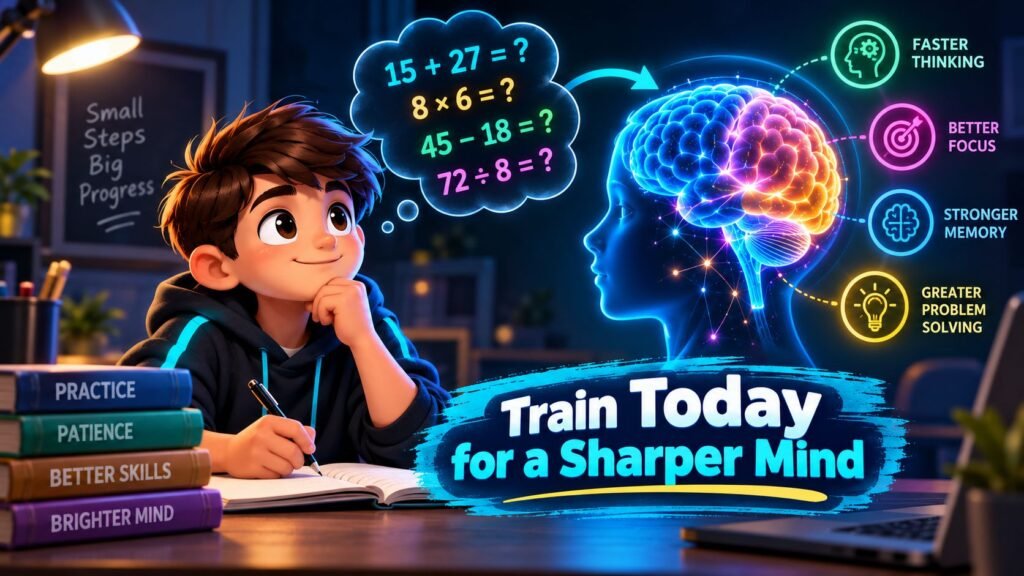
When you first encounter an unfamiliar calculation, you may need several deliberate steps to reach the answer. Practice can change how efficiently you handle similar problems.
Familiar Fact Retrieval
Consider 7 × 8. Someone who does not know the multiplication fact reliably might calculate it from other facts. With sufficient arithmetic knowledge and practice, the answer may instead be retrieved directly from memory.
That reduces the amount of calculation required.
The same principle can apply to common addition combinations, doubles, halves and other frequently used number relationships. Familiarity can therefore make a response faster without requiring you to consciously “think faster” in a general sense.
Better Mental Strategies
Mental math is not purely memorization. Efficient strategies matter too.
Suppose you need to calculate 49 + 36. Rather than treating it as a completely unfamiliar problem, you could think:
50 + 36 = 86
86 − 1 = 85
For 25 × 16, another person might recognize a useful relationship and choose an efficient route instead of performing a lengthy calculation mentally.
Practice gives you opportunities to recognize these structures and choose strategies that require fewer or simpler steps.
Working Memory and Attention
Mental arithmetic frequently requires holding numbers or intermediate answers in mind while continuing a calculation. It also requires enough attention to keep track of the operation and avoid losing your place.
This makes mental math a genuine cognitive task rather than simple button pressing.
However, using working memory during arithmetic does not prove that arithmetic practice will broadly improve working memory in every other situation. Research on cognitive training repeatedly finds that transfer tends to be stronger for trained or similar tasks than for distant, unrelated abilities.
Does Mental Math Improve Brain Speed Specifically?
If “brain speed” means how quickly you can solve familiar mental calculations, the practical answer is often yes: consistent practice can improve performance on the material being practised.
If it means that daily arithmetic will make every kind of thought, decision, reaction and memory operation faster, the evidence does not justify that conclusion.
This distinction is known as transfer.
Near transfer occurs when training helps performance on a similar task. For example, practising arithmetic strategies may help you handle other calculations that use related strategies.
Far transfer would mean that the training produces substantial improvements in abilities that are quite different from the original task, such as general intelligence or unrelated cognitive skills.
Research on cognitive training has found much stronger and more consistent evidence for training effects and near transfer than for broad far transfer. Some studies and reviews have reported improvements beyond the exact trained task, but the size and reliability of those effects depend heavily on the type of training, comparison group and outcome being measured.
So it is more accurate to say mental math can train mental calculation performance than to claim it universally speeds up the brain.
Mental Math vs Reaction Speed
Calculation speed and reaction time should not be confused.
Imagine a browser game displays:
12 + 9 = ?
Several stages happen before your response reaches the game. You first see the problem, recognize the numbers and operation, calculate or retrieve 21, decide how to respond, and then click, tap or press a key.
The final recorded time includes more than mental arithmetic.
A faster result after practice could come from quicker fact retrieval, a better calculation strategy, greater familiarity with the game, faster input, or a combination of these factors.
Device conditions can matter too. Keyboard, mouse and touchscreen inputs are not identical, and browser performance, display behavior and device latency can affect very small timing differences.
For this reason, a mental math game score should not be interpreted as a laboratory measurement of general reaction speed.
Speed and Accuracy
A player can make almost any timed arithmetic task faster by guessing. That obviously does not represent better mental math.
Accuracy should therefore be considered alongside speed.
If you solve 20 problems much faster than before but make considerably more errors, the faster completion time tells only part of the story.
A more useful approach is to establish reliable accuracy and then gradually reduce the time required.
For example, a beginner learning multiplication facts might first answer without a timer. Once the facts are reasonably familiar, gentle time pressure can be introduced. Later, short speed challenges can test whether answers remain accurate at a quicker pace.
This avoids teaching yourself to respond before you have finished thinking.
What Research Can Tell Us
Cognitive-training research provides an important warning against broad claims about “brain training.”
People commonly improve at tasks they practise. Improvements can also extend to sufficiently similar tasks. But researchers have had much more difficulty demonstrating reliable far transfer to substantially different abilities.
Research into working-memory training illustrates the problem well. Reviews have found improvements on trained working-memory tasks and, in some cases, closely related measures. However, rigorous analyses have generally found far weaker evidence that these gains reliably produce broad improvements in intelligence, academic performance or other distant skills.
More recent research continues to investigate how cognitive training changes task performance and patterns of brain activity. This is an active field, and outcomes can vary according to the training method, age group, amount of practice and measures used.
That makes a cautious interpretation appropriate for mental arithmetic.
Becoming quicker at mental math is meaningful progress. It simply should not be converted into an unsupported claim that someone’s overall intelligence or general brain speed has increased.
Factors That Affect Progress
Two people can follow similar practice routines and experience different results.
Starting ability matters. Someone who already knows basic arithmetic facts may spend more time developing efficient strategies, while a beginner may initially need to build factual knowledge.
Problem difficulty matters as well. Repeatedly answering calculations that are far below your current level may produce little challenge, while problems that are excessively difficult can make useful practice frustrating.
Technique is another factor. Learning efficient ways to decompose and recombine numbers can sometimes matter more than trying to force yourself to calculate the same inefficient way at greater speed.
Concentration, fatigue and the testing environment can also influence an individual session. A single unusually good or poor result should not be treated as proof of lasting change.
Age and previous mathematical experience can affect performance too, so direct comparisons between different players are often less informative than comparing your own results over time.
How to Practise Mental Math Daily
There is no universal number of minutes that everyone must practise to get useful results. Quality and consistency matter.
Start with calculations that are challenging enough to require attention but still appropriate for your current skill level.
Spend part of the session working without strong time pressure. This gives you room to think about efficient strategies rather than simply racing.
If a calculation causes repeated difficulty, examine why. Perhaps a multiplication fact is not yet familiar, a subtraction requires awkward regrouping, or you are using an unnecessarily long method.
Once you can solve a set accurately, add short timed rounds.
This creates a sensible progression:
accuracy → efficient strategy → fluency → controlled speed
Daily practice also does not mean you must push for a personal record every day. If concentration drops and mistakes increase, taking a break may be more productive than continuing to rush.
Measuring Real Improvement
If you want to know whether practice is helping, measure more than your fastest time.
Track both accuracy and completion speed. You could record how many questions you answer correctly in a fixed period or measure how long it takes to complete a comparable set accurately.
Testing conditions should remain reasonably consistent. Comparing a desktop keyboard attempt with a touchscreen attempt introduces an input difference. Changing problem difficulty makes another comparison less meaningful.
Practice effects matter as well. If you repeat exactly the same questions in exactly the same order, you may begin remembering the sequence rather than becoming broadly better at that type of calculation.
A useful check is to occasionally try unfamiliar problems of similar difficulty.
Suppose you initially complete a mixed arithmetic set accurately but slowly. After regular practice, you complete a new, comparable set more quickly while maintaining accuracy. That provides better evidence of improved arithmetic fluency than simply memorizing one repeated test.
It still does not demonstrate that every aspect of cognition has become faster.
Mental Math vs Calculator Use
Mental arithmetic and calculators serve different purposes.
Mental math is valuable when you want to estimate, check whether an answer seems reasonable, handle manageable calculations quickly, or practise number relationships.
Calculators are valuable when calculations become lengthy, precision is important, or manual computation would add unnecessary work.
Using a calculator is therefore not the opposite of being good at mathematics.
A sensible goal is knowing when mental calculation is efficient and when a tool is more appropriate. Mental math practice develops one set of mathematical skills; calculator use supports other tasks where accuracy and efficiency are priorities.
Common Misunderstandings
One misconception is that fast arithmetic automatically demonstrates high intelligence. It does not. Arithmetic speed is influenced by knowledge, practice, familiarity with the problem type, strategy and testing conditions.
Another is that reaction speed and calculation speed are interchangeable. They involve different processes.
Timed practice is also not automatically superior to untimed practice. Time limits can create a useful challenge once the underlying calculation is understood, but beginners may benefit from learning accurate strategies before emphasizing speed.
Similarly, harder problems are not necessarily better training. Appropriate difficulty is more useful than difficulty for its own sake.
Most importantly, a score in an online math or reaction game should not be used to diagnose intelligence, attention, memory problems, learning ability or a medical condition.
Mental Math for Kids and Beginners
For beginners, understanding should come before racing.
Start with arithmetic appropriate to the learner’s current knowledge. Familiar addition and subtraction relationships or multiplication facts may be more useful than introducing complicated calculations simply to make practice feel difficult.
Games can make repetition more interactive, especially when they provide immediate responses and short rounds. They are best viewed as one practice format rather than a replacement for understanding mathematical concepts.
Speed comparisons between children should also be treated carefully. A slower answer does not by itself reveal why someone took longer.
Encourage the learner to notice personal progress: fewer mistakes, more familiar facts, better strategies and eventually quicker accurate answers.
Using Browser Games for Practice
Browser-based math games can provide a convenient way to combine arithmetic with short, repeatable challenges.
A mental math reaction game, for example, adds a response component after the calculation. Addition, subtraction, multiplication and division challenges can provide more focused practice with individual operations.
Number typing activities emphasize accurate keyboard input as well as number recognition, while dedicated reaction games place more emphasis on responding to a stimulus.
These activities should not all be treated as measuring the same ability. Instead, varying the task can make practice more interesting while showing how calculation speed, accuracy and physical response differ.
Frequently Asked Questions
Does mental math improve brain speed?
Mental math practice can make familiar calculations and related arithmetic tasks faster and more efficient. There is much less support for interpreting this as a general increase in the speed of all brain processes.
Can daily mental math make calculations faster?
Regular practice can improve arithmetic fluency, particularly when you practise relevant facts and efficient strategies while maintaining accuracy. Progress varies according to experience, difficulty and the quality of practice.
Does mental math improve reaction time?
Mental calculation and reaction time are different abilities. A person may respond faster in a practised math game because calculation has become more efficient, but that does not necessarily mean their general reaction time has improved.
Is mental math good for working memory?
Many mental calculations use working memory because you must temporarily hold numbers and intermediate results while solving a problem. Practising such calculations exercises those processes during the task, but broad improvements in working memory outside the trained context should not be assumed.
Is speed or accuracy more important?
Accuracy should usually come first. Once you can solve calculations reliably, gradually working on speed can help develop arithmetic fluency without encouraging guessing or careless responses.
Final Summary
So, does mental math improve brain speed with daily practice? It can improve the speed and fluency of mental calculations, especially when practice builds familiar fact retrieval and more efficient strategies. Those are useful, measurable skills.
The evidence is less convincing for the much broader idea that arithmetic practice makes the entire brain faster or increases general intelligence. For useful practice, focus on correct answers first, develop efficient mental strategies, introduce speed gradually, and measure accuracy alongside time.