Free Online Game
Why Try Color Memory Activities for Adults for Brain Practice?
Color memory activities for adults can be a useful way to practise visual recall, attention, sequence tracking, and pattern recognition in a simple, engaging format. They are not a measure of intelligence and should not be treated as a medical or cognitive assessment, but they can provide a focused mental challenge that is easy to adjust to different ability levels.
The basic idea is straightforward: look at colors, remember what you saw, and then reproduce the information correctly. Depending on the activity, that may mean recalling a sequence, finding matching colors, rebuilding a pattern, or noticing which color has changed.
Because the rules are usually simple, these activities work well for short browser-based practice sessions as well as offline exercises using cards, blocks, or colored objects.
What Are Color Memory Activities for Adults?
Color memory activities are tasks that use colors as information the player needs to remember for a short period.
Some activities ask you to recall which colors appeared. Others require you to remember their positions, their order, or the way several colors were arranged together.
For example, a game may flash cyan, green, yellow, and magenta in a particular sequence. After the sequence disappears, you must reproduce it in exactly the same order.
Another activity might show a grid of colored squares for several moments, hide it, and then ask you to rebuild the original arrangement.
Although these tasks may look simple, they can involve several kinds of attention at once. You may need to distinguish colors, track location, retain the order of items, and ignore distractions while responding.
How Color Memory Activities Work
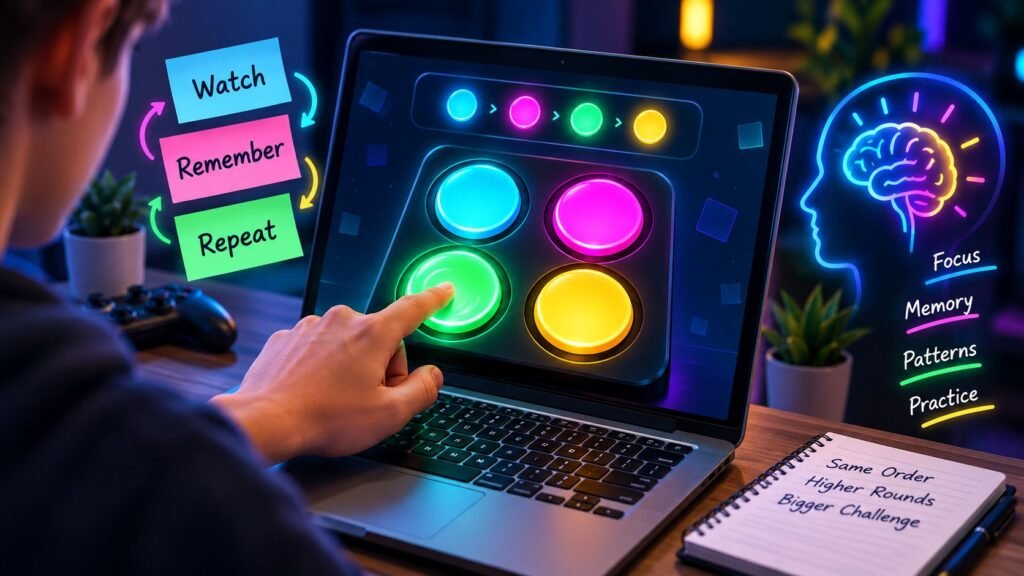
Most color-based memory tasks follow a simple cycle:
- Observe the colors or pattern.
- Hold the information briefly in mind.
- Recall, recognize, or reproduce it.
- Check the result.
- Try a slightly harder version when appropriate.
The challenge changes depending on what you are being asked to remember.
Color Matching
In a matching activity, several colored cards or tiles are hidden. You reveal them one or two at a time and try to remember where each matching color is located.
This requires you to connect color with position rather than simply identify the color itself.
Sequence Recall
Sequence games focus on order.
You might see green, cyan, yellow, magenta and then need to enter those colors in that exact sequence. As the game continues, another color may be added to the pattern.
This type of activity is especially useful for practising serial recall because getting all the right colors in the wrong order still produces an incorrect answer.
Pattern Recognition
Pattern activities use complete arrangements rather than individual colors.
You may be shown a row, grid, or group of colored shapes and then asked to identify what changed, continue the pattern, or rebuild the original layout.
These tasks can combine color recall with position and visual organization.
Why Try Color Memory Activities for Adults?
The main reason to try them is that they provide a clear and adjustable form of brain practice.
A short color-memory challenge can ask you to concentrate on visual details, hold information briefly, and respond accurately. That makes it different from passive activities where you are only looking at information.
Color can also provide an easy way to organize visual material. Instead of remembering abstract symbols, you may find it more natural to think in terms of green, yellow, magenta, or cyan.
Some people prefer naming the colors mentally. Others remember where the colors appeared or visualize the movement between positions. Neither approach is automatically better; different strategies can suit different players and different tasks.
Practice should also be kept in perspective. Getting better at a specific color-memory game mainly shows that you are becoming more familiar with that task. It should not be assumed that a higher game score means broad improvements in memory, intelligence, or other abilities.
Color Memory Activities to Try
You do not need complicated equipment to create useful memory challenges. The following activities can be adapted for browser play or offline practice.
Watch and Repeat a Color Sequence
Start with three colors.
For example:
Green → Yellow → Cyan
Look at the sequence, hide it, and reproduce it.
If you can do that comfortably, add another item:
Green → Yellow → Cyan → Magenta
Continue increasing the length gradually.
The important part is the order. Try not to rush simply because the sequence is familiar.
Remember the Positions
Place four or more colored objects in different positions.
Study the layout briefly, then cover the objects. Try to recall where each color was located.
For a harder version, change one position and identify what moved.
This adds a spatial element because you must remember both the color and its location.
Find the Changed Color
Create a row such as:
Cyan – Green – Yellow – Magenta
Look away while one color is replaced.
You then need to identify which position changed and what the original color was.
Start with a small number of items before increasing the size of the pattern.
Rebuild a Color Pattern
Create a small grid of colored blocks or tiles.
Study it for a short period, remove the example, and rebuild the layout from memory.
You can increase difficulty by adding more positions rather than immediately reducing viewing time.
Match Hidden Color Pairs
Use pairs of matching colored cards.
Turn over two cards at a time. When they do not match, turn them back and try to remember their locations.
As more cards are revealed, you build a mental map of where each color is located.
How to Build a Practice Session
A good practice session does not need to be complicated.
Begin at a level where you can understand the rules immediately. If you are using a sequence activity, start with only a few colors. If you are working with positions, use a small grid.
Complete several attempts before changing the difficulty.
Once the current level feels manageable, change one factor at a time.
You might:
- Add one more color to the sequence.
- Add another tile to the grid.
- Introduce more similar-looking colors.
- Increase the number of matching pairs.
- Reduce the viewing period slightly.
Changing several things at once makes it harder to tell why an activity suddenly became difficult.
It is also reasonable to stop when your concentration clearly falls. A longer session is not automatically more useful than a shorter, focused one.
Making the Activities More Challenging
The easiest way to increase difficulty is to increase the amount of information you need to remember.
A three-color sequence is easier to manage than an eight-color sequence because there are fewer positions to track.
You can also combine different types of information. Instead of remembering only color, you might remember color plus location.
For example:
- Cyan in the top-left position.
- Green in the bottom-right position.
- Yellow in the center.
Another option is to make colors more similar. Distinguishing bright yellow from dark blue is usually simpler than distinguishing two closely related shades.
However, very similar colors may create accessibility problems for some players, so adding shapes or position cues can make the task clearer.
Tips for Better Practice
One useful technique is to focus on structure rather than isolated colors.
Suppose the sequence is:
Green – Green – Yellow – Cyan – Cyan – Magenta
Instead of memorizing six separate items, you might think:
Two green, yellow, two cyan, magenta.
Another approach is to divide a longer sequence into smaller groups.
Cyan – Green – Yellow – Magenta – Cyan – Yellow
could become:
Cyan – Green – Yellow
then:
Magenta – Cyan – Yellow
This type of grouping can make a long sequence easier to organize.
Position can help too. If colored buttons stay in fixed places, you may remember a movement such as top-left, bottom-left, top-right rather than repeatedly naming every color.
Try several methods and use the one that feels clearest.
Common Mistakes
A common mistake is increasing difficulty too quickly.
If you move from three colors to eight before the shorter pattern feels comfortable, errors may tell you little except that the jump was too large.
Another mistake is focusing only on which colors appeared and forgetting their order. In sequence tasks, order is part of the challenge.
Speed can also become a distraction. Unless the activity specifically includes timed input, there is little reason to rush the response. Accurate recall is often the more useful target.
Avoid comparing scores from completely different games as if they measure the same ability. A matching game, sequence game, reaction task, and visual pattern test may use different rules, timing, and difficulty systems.
Digital vs Physical Activities
Digital and physical color activities each have advantages.
Browser-based games can automatically generate new patterns, increase difficulty, track rounds, provide immediate feedback, and repeat sequences consistently.
They are also convenient because no preparation is required.
Physical activities offer more flexibility. You can create your own layouts using cards, colored paper, blocks, or household objects. You can also adjust the task instantly by moving items or changing the number of colors.
Neither format is inherently better. The better choice is the one that keeps the activity clear, manageable, and enjoyable.
Color Sequence Games for Online Practice
A color sequence game is one of the most direct digital versions of this type of activity.
The game shows a series of colored buttons or pads in a particular order. After the demonstration finishes, you repeat the sequence.
A typical challenge may begin with one or two colors and gradually add more as you complete rounds.
Some games also increase playback speed, which makes later sequences more demanding because you have less time to observe each cue.
Mouse, keyboard, and touchscreen controls can all work well depending on the game. Keeping one control method throughout a session may help you focus more on the pattern itself.
Scores and rounds can provide useful feedback, but it is usually more meaningful to compare your performance with your own previous attempts under similar conditions.
Important Limitations
Performance on color memory activities for adults can vary for many ordinary reasons.
Fatigue, distraction, screen brightness, unfamiliar controls, viewing distance, device size, and experience with the activity can all influence how easy or difficult a task feels.
Age may also influence performance on some visual working-memory tasks, but differences between individuals are substantial. A single game score cannot provide a complete picture of a person’s memory.
Color perception matters as well. People who find certain colors difficult to distinguish may perform better with activities that combine colors with symbols, shapes, sounds, or fixed positions.
Most importantly, these activities are designed for practice and entertainment, not diagnosis. They should not be used to determine whether someone has a memory disorder, attention condition, learning difficulty, or neurological problem.
Related Brain-Practice Activities
Color memory is only one type of visual challenge.
You can also try visual pattern games that ask you to remember locations, short-term sequence games using numbers or symbols, reaction games that require quick responses to changing targets, or typing exercises that combine attention with accurate keyboard input.
Mental math challenges offer a different kind of practice because they require you to hold numbers or partial answers briefly while completing a calculation.
Switching between different activities can keep practice varied without assuming that every task trains the same skill.
Frequently Asked Questions
What are color memory activities for adults?
They are activities that ask adults to remember colors, sequences, positions, matches, or visual patterns for a short period. They can be played digitally or created with physical objects.
What skills can color memory activities help adults practise?
They can provide practice with visual recall, sequence tracking, concentration, pattern recognition, attention to detail, and remembering locations. They should not be treated as guaranteed methods for improving general cognitive ability.
How difficult should a color memory activity be?
Start at a level where you can understand and complete at least some attempts successfully. Increase difficulty gradually by adding colors, positions, or sequence length rather than changing everything at once.
Can color memory activities for adults be played online?
Yes. Browser-based sequence, matching, and visual pattern games can provide convenient online practice. Digital games can also automate pattern generation, scoring, and difficulty changes.
Are color memory games intelligence tests?
No. A color memory game measures performance on that particular task under specific conditions. Scores can be influenced by attention, experience, device conditions, color perception, and many other factors, so they should not be used as a measure of overall intelligence.
Keep the Practice Simple
The most useful way to approach color memory activities is to keep the challenge manageable and increase difficulty gradually.
Start with short sequences or small patterns, concentrate on accuracy, and change only one difficulty factor at a time. Use grouping, positions, or simple mental labels if they help you remember the pattern.
Color memory activities for adults can be an enjoyable way to practise visual attention and short-term pattern recall, especially when the goal is personal practice rather than chasing a particular score.