Free Online Game
How to Improve Attention Span With Games: Practical Guide
If you want to learn how to improve attention span with games, the most useful approach is not to play randomly for long periods. Instead, choose games that require a specific type of attention, establish a baseline, practise under consistent conditions, and track how your performance changes within those tasks.
Games can give you a structured way to practise selective attention, sustained focus, visual recognition, response control, and short-term memory. However, better performance in a game does not automatically mean that attention will improve in every part of daily life. Treat gaming as focused practice and entertainment rather than as a medical treatment or diagnostic test.
This guide shows you how to build a simple, repeatable routine using short browser games on HitTheButton.io.
Understand What You Are Practising
“Attention span” is a broad phrase. Different games can place different demands on your attention, so it helps to know what you are trying to practise.
Sustained attention involves staying engaged with a task for a period of time. A timed game that requires you to keep watching for a target can provide this type of challenge.
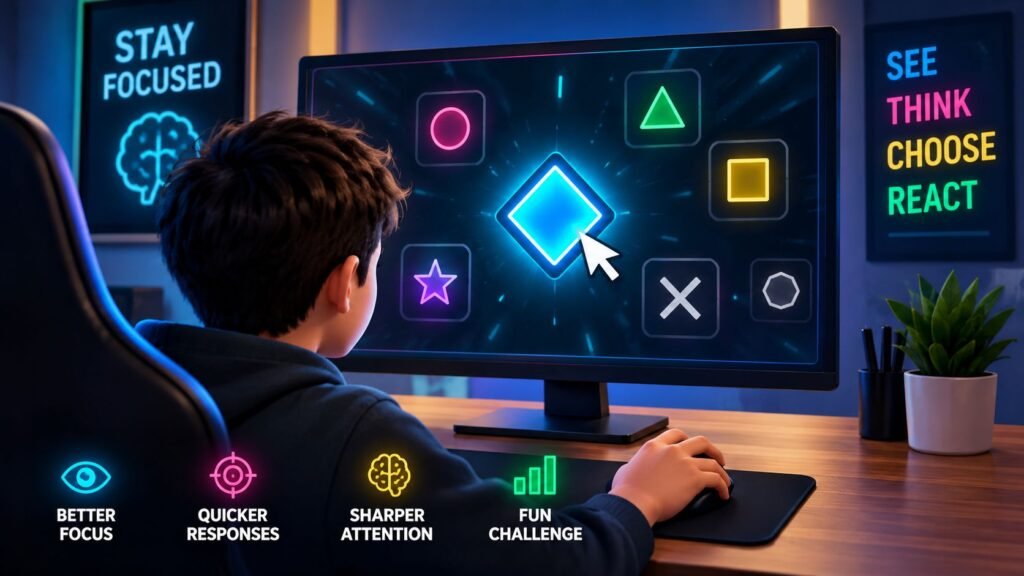
Selective attention means concentrating on relevant information while ignoring distractions. For example, the Attention Span Test Online Game displays a target diamond alongside various distracting symbols. You must respond to the diamond and leave the other shapes alone.
Response control involves deciding not only when to act but also when not to act. A game can become much more demanding when incorrect or premature responses have consequences.
Memory games add another element. They may ask you to hold a visual pattern or sequence in mind before reproducing it.
Instead of trying to train everything simultaneously, identify one skill you want to practise first.
Prepare Before You Start
You do not need a complicated setup. You do, however, need conditions that make your results reasonably comparable.
Choose a browser game with clear rules and measurable results. Close unnecessary applications if they are affecting browser performance, and silence notifications that repeatedly pull your attention away.
Use a comfortable device and input method. If you start your baseline on a laptop using a keyboard, try to use the same setup when you retest. A phone touchscreen and desktop keyboard do not necessarily produce directly comparable game results.
The same principle applies to test length. A 60-second focus challenge should generally be compared with another attempt at the same challenge, rather than with a much shorter reaction test.
Take a Baseline Test
Before beginning regular practice, establish a starting point.
Use the Attention Span Test Online Game or another focus-based game and complete a normal attempt without warming up through many repeated rounds first.
Record the information the game provides, such as score and accuracy. For the Attention Span Test, also notice how many errors you make by selecting distractors, responding too early, or missing the target.
Do not worry if your first result is lower than expected. Its purpose is simply to provide a reference point.
A useful baseline note might contain:
- Game played
- Device used
- Mouse, keyboard, or touchscreen
- Test duration
- Score
- Accuracy, when available
- Number or type of mistakes
- Anything unusual about the session
You do not need to record every tiny detail forever. The goal is to make later comparisons more meaningful.
How to Improve Attention Span With Games Step by Step
Use the following method to turn casual game sessions into more structured attention practice.
- Start with one short focus challenge.
Choose a game that makes the required response obvious. In the Attention Span Test, for example, the diamond is the target and the other symbols are distractors. A simple rule allows you to concentrate on attention and response control instead of spending most of the session learning complicated mechanics. - Learn accuracy before chasing a high score.
For your first few attempts, concentrate on making the correct decision. In a selective-attention game, clicking quickly is not useful if you repeatedly select distractors. Try to distinguish the target first and respond second. This develops a more controlled playing technique. - Practise ignoring distractions deliberately.
Do not think of a non-target symbol as a period when nothing is happening. Correctly ignoring it is part of the task. When a circle, square, star, or another distractor appears, consciously recognize that it is not the target and wait for the next stimulus. - Avoid anticipation.
Some reaction games punish an early response, and anticipation can make results less representative of controlled performance. Keep your finger ready, but wait for the correct signal. If you notice yourself tapping or pressing before you have identified the target, slow down for the next attempt. - Let difficulty increase naturally.
You do not need to jump immediately to the hardest task available. The Attention Span Test becomes faster across its eight levels during a 60-second attempt. Concentrate on maintaining the same decision rule as the response window becomes shorter. Progression is more useful when you can still perform the task deliberately rather than relying on guesses. - Repeat under similar conditions.
If you are tracking performance, use the same game, device, input method, and test duration where practical. This reduces the number of unrelated variables affecting the comparison. - Stop before practice becomes careless.
Repeated attempts can eventually turn into automatic clicking, frustration, or score chasing. If your errors rise and you are no longer following the task carefully, take a break. More attempts are not automatically better practice.
Practical Attention Exercises
Variety can be useful when each game has a clear purpose. Rather than switching games after every attempt, use different challenges for different skills.
Target-and-Distractor Exercise
Play the Attention Span Test Online Game and make accuracy your priority.
Respond only to the diamond. Allow every distractor to disappear without responding. Try to complete the full 60 seconds without losing all three Focus points.
Afterward, ask yourself what caused your mistakes. Did you mistake another shape for the diamond? Did you press too early? Did you see the diamond but respond too late?
That distinction is more useful than simply thinking, “I need a higher score.”
Reaction Control Exercise
Use the Keyboard Reaction Time Test for a different type of challenge.
Keep your hand ready but avoid predicting when the signal will arrive. The exercise is to connect the correct visual event with a controlled response.
Reaction practice and selective-attention practice are related but not identical. Alternating them can provide variety without pretending they measure the same ability.
Visual Pattern Exercise
Try the Visual Pattern Memory Game when you want a task involving visual attention and memory.
Give the displayed pattern your full attention while it is visible. Avoid looking elsewhere at the score or surrounding page. When it is time to respond, reproduce what you remember rather than guessing rapidly.
Sequence and Short-Term Memory Exercise
The Vexle Sequence Game can be used for following an ordered sequence, while the Short Term Memory Test Game provides another way to practise briefly holding information in mind.
The goal is not to prove that one game is “better for your brain.” Each simply provides a different structured task requiring attention to particular information.
Build a Short Daily Routine
Long sessions are unnecessary for this type of practice. A short routine is easier to repeat and less likely to turn into tired, careless play.
Try this simple 15-minute structure:
Minutes 1–2: Prepare your environment. Silence unnecessary notifications, get comfortable, and choose the skill you are practising.
Minutes 3–7: Play a selective-attention challenge. Complete a small number of focused attempts rather than restarting whenever you make one mistake.
Minutes 8–12: Switch to a reaction, visual-pattern, or memory challenge.
Minutes 13–15: Stop playing and review your results. Note your accuracy, mistakes, and whether your performance became less controlled near the end.
If you feel mentally tired earlier, stop earlier. There is no benefit in forcing yourself through a fixed schedule simply to complete the minutes.
You can practise several days per week rather than treating the routine as an obligation every day. Consistency may help you develop familiarity and technique within the games, but individual results vary and improvement is not guaranteed.
Common Practice Mistakes
The biggest mistake is treating every game as a pure speed test.
In the Attention Span Test, a fast wrong response costs Focus. You need to recognize whether the symbol is the target before acting. Accuracy and restraint therefore matter alongside speed.
Another problem is changing conditions constantly. Suppose you establish your baseline using a desktop computer and keyboard, then compare it with a touchscreen attempt on a smaller phone. Differences in screen size, input method, browser performance, and familiarity can affect the result.
Playing too many attempts in succession can also distort comparisons. Later scores may reflect growing familiarity with the game, but they can also be affected by fatigue or reduced motivation.
Finally, avoid interpreting one unusually good or bad result as a major change in your attention. Game performance naturally varies from attempt to attempt.
Measure Your Progress
Progress tracking works best when you compare like with like.
Retest periodically using the same game and similar conditions. You might choose one planned comparison each week instead of treating every casual attempt as a formal test.
Record score, but do not rely on score alone.
Accuracy can show whether a higher score came with better decision-making or simply more aggressive responding. In the Attention Span Test, also consider whether you are preserving more Focus points and making fewer wrong or early responses.
Device conditions matter as well. A keyboard can have different input characteristics from a touchscreen or mouse. Browser load, background applications, display size, refresh behavior, and general device performance can also influence interactive games.
For useful comparisons, try to keep these factors stable:
- Device type
- Keyboard, mouse, or touchscreen
- Browser environment
- Screen size
- Test duration
- Rest before the test
- Number of warm-up attempts
- Background applications
- Sound and notification conditions
A result from a 60-second test should not automatically be compared with one from a different test length. Likewise, scores from two different games may use completely different scoring rules.
Track improvement within the same task first.
Device and Environment Considerations
Desktop play offers a larger viewing area and lets you choose between keyboard and mouse controls in supported games. Mobile play can be convenient but uses touch input and a smaller screen.
Neither setup needs to be considered universally better. What matters for progress tracking is consistency.
Place the screen where you can see the entire game area comfortably. If you are practising a game where targets appear in different positions, you should not need to repeatedly reposition the page during an attempt.
Notifications deserve special attention. A message appearing over the game introduces an external distraction that was not part of the intended challenge.
If your goal is specifically to practise ignoring the distractors built into a game, reducing unrelated interruptions gives you a cleaner practice session.
Know the Limits of Game Practice
Attention games provide tasks in which you can practise skills such as identifying targets, ignoring distractors, maintaining focus for a timed period, remembering patterns, and controlling responses.
What they cannot do is guarantee broad changes in everyday concentration.
Research on cognitive and game-based training shows an important distinction between getting better at trained or similar tasks and transferring those gains to very different real-world activities. Evidence for broader transfer is mixed and depends on the training method, task, population, and outcome being measured.
For that reason, treat a better game score as evidence that your performance in that game has changed, not proof that every aspect of your attention has improved.
Online scores also cannot diagnose ADHD, learning difficulties, intelligence, or any medical or psychological condition. If attention difficulties are persistent and are significantly affecting school, work, relationships, safety, or everyday functioning, a browser game is not a substitute for appropriate professional assessment.
Related HitTheButton.io Games
You can build a varied practice routine using different HitTheButton.io challenges.
The Attention Span Test Online Game is suitable for practising selective responses because you must identify the diamond and ignore competing shapes.
The Keyboard Reaction Time Test shifts the emphasis toward responding to a visual signal with a keyboard input.
The Visual Pattern Memory Game provides a visual attention and recall challenge, while the Vexle Sequence Game requires you to follow and remember sequences.
The Short Term Memory Test Game offers another memory-focused task. For something that combines decision-making with a simple mental task, the Mental Math Reaction Game provides a different style of challenge.
Rotate games because you want to practise different tasks, not because changing games constantly guarantees faster improvement.
Frequently Asked Questions
How can I improve attention span with games?
Choose games with clear attention demands, establish a baseline, practise accuracy and response control, keep sessions manageable, and retest under similar conditions. Focus on getting better at the specific task rather than assuming every score increase represents a general improvement in attention.
How long should attention game practice last?
There is no single ideal duration for everyone. A short session of around 10–15 minutes can be a practical starting point for recreational practice. Stop sooner if you become tired, frustrated, or start responding carelessly.
Should I focus on accuracy or speed first?
Accuracy is usually the better starting priority when the game requires you to choose between targets and distractors. Once you can follow the rule consistently, you can work on responding more efficiently without sacrificing correct decisions.
Should I play the same attention game every day?
Repeating the same game can help you learn its specific demands and makes progress easier to compare. You can also include reaction, pattern, sequence, and memory games for variety. Just remember that scores from different games are not directly interchangeable.
Can attention games diagnose ADHD or poor concentration?
No. Browser games can provide entertainment and structured attention practice, but their scores should not be used to diagnose ADHD, attention disorders, learning difficulties, or other health conditions.
Your Practical Action Plan
Start by choosing one game and taking a baseline attempt under comfortable, distraction-reduced conditions. Record the device, input method, score, accuracy, and the mistakes you notice.
For the next practice session, spend about five minutes on selective attention and another five minutes on a reaction, pattern, or memory task. Rest between repeated attempts instead of playing continuously.
Keep accuracy and controlled responses ahead of score chasing. Use the same device and test conditions whenever you want a meaningful comparison.
After roughly a week of regular, manageable practice, repeat your original baseline game under similar conditions and compare the results. Look at accuracy and errors as well as the total score.
That is the most practical way to approach how to improve attention span with games: practise specific attention-related skills, keep the sessions controlled, measure the same task consistently, and treat any progress as game-performance improvement rather than a guaranteed change in everyday attention.