Free Online Game
Mental Subtraction Tricks for Kids: A Practical Guide
Learning a few reliable mental subtraction tricks for kids can make subtraction feel more manageable because children do not have to approach every calculation in exactly the same way. The aim is not simply to answer faster. It is to recognise the structure of a problem, choose a sensible strategy, calculate accurately, and gradually rely less on counting every step.
This guide starts with easy subtraction facts and moves toward methods such as counting back, bridging through ten, partitioning, and compensation. Children can practise with paper, objects, number lines, or short browser-based challenges. The difficulty should match what the child already understands, and accuracy should come before speed.
Start with Simple Mental Subtraction
Mental subtraction means working out a difference mainly in your head rather than depending on written column subtraction or a calculator.
A child does not need to abandon fingers, counters, or number lines immediately. These can be useful ways to make a calculation visible. The goal is to gradually connect those representations with mental strategies.
For example, a child solving 9 − 3 might initially count backwards:
9, 8, 7, 6.
With practice, the fact that 9 − 3 = 6 may become familiar enough to recall without counting each step.
Before moving to larger calculations, check that the child is reasonably comfortable counting forwards and backwards, recognising numbers, and understanding that subtraction can describe taking away or finding a difference.
Try a Simple Baseline Test
Before teaching several new strategies at once, establish a simple starting point.
Use 10 subtraction questions appropriate for the child’s current level. For a beginner, these might include:
8 − 3
10 − 6
9 − 2
7 − 5
12 − 4
15 − 5
13 − 3
14 − 6
17 − 7
20 − 8
Do not make the first test unnecessarily stressful. The purpose is to discover what is already comfortable and what needs practice.
Record three things:
- Number answered correctly
- Approximate completion time
- Types of questions that caused difficulty
Accuracy is usually the most useful starting measure. A child who answers 9 out of 10 correctly at a comfortable pace has a different practice need from a child who races through the same questions but makes several mistakes.
Keep this first result so future attempts can be compared under similar conditions.
Mental Subtraction Tricks for Kids
Different calculations suit different strategies. Rather than teaching one “magic trick,” help the child build a small collection of methods and learn when each one is useful.
A practical sequence is:
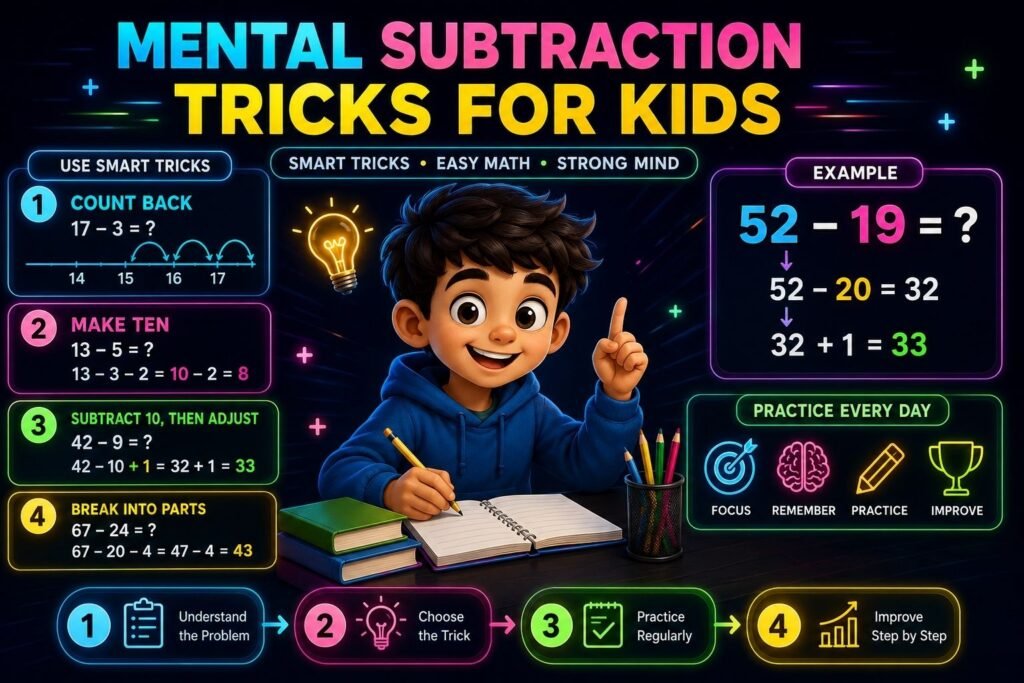
- Start with counting back for small amounts. For 12 − 3, begin at 12 and move back three steps: 11, 10, 9. The answer is 9. A number line can make the movement visible at first.
- Use number bonds and known facts. If the child already knows 6 + 4 = 10, connect it with 10 − 6 = 4 and 10 − 4 = 6. Linking addition and subtraction can reduce the need to recalculate familiar facts.
- Bridge through ten. For 13 − 5, split 5 into 3 and 2. First calculate 13 − 3 = 10, then 10 − 2 = 8. Reaching a friendly number such as 10 makes the remaining calculation simpler.
- Partition larger numbers. For 47 − 23, split 23 into 20 and 3. Calculate 47 − 20 = 27, then 27 − 3 = 24. This keeps the calculation in manageable pieces.
- Use compensation for numbers close to a ten. For 52 − 19, subtract 20 first: 52 − 20 = 32. Because you subtracted one too many, add 1 back. The answer is 33.
- Compare strategies. Ask which method feels clearest for a particular problem. A child might use counting back for 15 − 2 but compensation for 35 − 9. The aim is flexible calculation, not forcing every problem through the same procedure.
These steps should be introduced gradually. If one method is still confusing, practise it with smaller numbers before adding another.
Use the Count-Back Method
Counting back is especially straightforward when the amount being subtracted is small.
Consider:
16 − 3
Start at 16 and make three backward moves:
15, 14, 13.
Therefore, 16 − 3 = 13.
A number line can help a beginner see what those movements mean. Place a finger or counter on 16 and move left three spaces.
Try:
9 − 2
14 − 3
18 − 4
21 − 2
Counting back becomes less efficient when the second number is large. For 63 − 27, making 27 individual backward counts creates many opportunities to lose track. That is a good signal to choose another strategy.
Bridge Through Ten
Crossing a multiple of ten can initially make subtraction feel harder. Breaking the amount being subtracted into two parts can simplify it.
Take:
14 − 6
Instead of counting six individual steps backwards, first ask:
How much must be subtracted from 14 to reach 10?
The answer is 4.
Split 6 into 4 + 2:
14 − 4 = 10
10 − 2 = 8
So 14 − 6 = 8.
Try the same idea with:
12 − 5 = 12 − 2 − 3
15 − 7 = 15 − 5 − 2
17 − 9 = 17 − 7 − 2
Ten frames, counters, or a number line can help make this process visible before expecting a child to perform every step mentally.
Subtract 10, Then Adjust
Numbers such as 9 and 11 are close to 10, which makes compensation particularly useful.
For:
34 − 9
Subtract 10:
34 − 10 = 24
You removed one too many, so put one back:
24 + 1 = 25
Therefore:
34 − 9 = 25
For 34 − 11, do the opposite adjustment:
34 − 10 = 24
24 − 1 = 23
Once that pattern is understood, similar thinking can be extended carefully to numbers near other multiples of ten.
For example:
63 − 19
Subtract 20 first:
63 − 20 = 43
Then add 1 back:
43 + 1 = 44.
The important part is understanding why the adjustment is needed. Memorising “subtract 20 and add 1” without understanding the reason can lead to errors when the numbers change.
Break Numbers into Smaller Parts
Partitioning means breaking a number into useful parts.
Consider:
68 − 24
Split 24 into 20 and 4.
68 − 20 = 48
48 − 4 = 44
So:
68 − 24 = 44
This strategy is useful because subtracting whole tens is often simpler than trying to process the entire calculation at once.
It can also be combined with bridging. For example:
72 − 26
First subtract 20:
72 − 20 = 52
Then subtract 6. A child might calculate 52 − 2 = 50 and then 50 − 4 = 46.
The calculation has become:
72 − 20 − 2 − 4 = 46.
There is no requirement to make every subtraction problem a one-step mental calculation. Breaking a difficult problem into sensible smaller steps is itself an important calculation skill.
Use Known Number Facts
Familiar number relationships can act as shortcuts.
If a child knows:
7 + 3 = 10
then related subtraction facts include:
10 − 7 = 3
10 − 3 = 7
The same principle works with other known facts.
Knowing doubles can also help with nearby relationships. If 8 + 8 = 16 is familiar, the relationship between 16, 8, and 8 is already available when thinking about 16 − 8.
Practise these connections by giving a number fact and asking for related calculations rather than treating addition and subtraction as completely separate topics.
Choose the Right Strategy
A useful mental calculator does not use the longest method automatically.
Consider these examples:
18 − 2: count back or recall the fact.
15 − 7: bridge through 10 if that makes the calculation easier.
46 − 20: subtract the tens directly.
52 − 9: subtract 10 and add 1.
67 − 23: partition 23 into 20 and 3.
After solving a question, occasionally ask, “Could we solve that another way?”
For 42 − 19, one child might use compensation:
42 − 20 = 22
22 + 1 = 23
Another might partition:
42 − 10 = 32
32 − 9 = 23
Both reach the same result. Comparing methods helps children notice that some approaches are more convenient for particular numbers.
Practise with Simple Exercises
Practice does not need to consist of long worksheets.
Use short sets that focus on one strategy.
For counting back:
15 − 2
17 − 3
20 − 4
For bridging through ten:
13 − 5
16 − 8
12 − 7
For compensation:
31 − 9
54 − 19
72 − 11
For partitioning:
48 − 23
67 − 34
85 − 42
Another useful exercise is a missing-number challenge:
15 − ? = 9
This encourages the child to think about the relationship between the starting number, the amount removed, and the difference.
Once untimed practice is comfortable, a short subtraction game can add a different type of challenge. Timed practice should complement understanding rather than replace it.
Follow a Short Daily Routine
A simple practice session can take around five to ten minutes. There is no need to turn every session into a long test.
A practical routine is:
Minutes 1–2: Review several easy subtraction facts the child already knows.
Minutes 3–4: Practise one strategy, such as bridging through ten.
Minutes 5–6: Mix that strategy with previously learned methods.
Minutes 7–8: Try one short game or timed challenge if the child is comfortable with time pressure.
Then review any mistakes calmly.
For a younger child or beginner, an even shorter session may be more appropriate. If concentration or accuracy drops noticeably, stop and return later rather than extending practice simply to complete a fixed duration.
Consistency can provide repeated opportunities to practise, but children progress at different rates.
Use the Subtraction Speed Test
Once basic strategies are understood, the Subtraction Speed Test Online on HitTheButton.io can provide a short practice challenge.
The game gives players 60 seconds and three lives. A subtraction equation appears with four possible answers. Players choose the correct result using the on-screen buttons or number keys 1–4.
Correct answers increase the score. Incorrect answers cost a life. After every five correct answers, the level rises, and higher levels use a larger number range.
This format makes accuracy important. Clicking randomly may be fast, but three mistakes can end the run before the timer reaches zero.
A useful approach is to play one attempt, rest briefly, and then discuss a few questions that felt difficult. The game score can be used to compare personal attempts, but it should not be treated as a measurement of intelligence or overall mathematical ability.
Avoid Common Mistakes
The first common mistake is rushing toward speed before the method is secure. If a child repeatedly answers incorrectly, remove the timer and return to smaller examples.
Another problem is counting back for everything. Counting back three places is reasonable; counting back 28 individual places is cumbersome and easy to lose track of. Introduce partitioning or compensation when the numbers make those methods more efficient.
Compensation creates another common error. With 45 − 9, subtracting 10 gives 35, but the calculation is not finished. One must be added back to reach 36.
Children may also try to memorize a rule without understanding it. If “subtract 10, add 1” becomes confusing, demonstrate 9 as “one less than 10” using counters or a number line.
Mistakes can reveal which part of the strategy needs more explanation, so correcting the reasoning is usually more useful than simply marking the answer wrong.
Measure Progress Fairly
Retest periodically using questions of similar difficulty to the original baseline.
Compare:
- Accuracy
- Completion time
- Strategies used
- Types of mistakes
- Amount of help required
Look at accuracy and technique before celebrating a faster time. A quicker result with substantially more mistakes may not represent better subtraction practice.
For digital tests, keep conditions reasonably consistent when comparing scores. A desktop keyboard, mouse, touchscreen, screen size, browser performance, background activity, and test length can affect how quickly a player interacts with a game.
Use the same device and the same test length where practical. Allow a short rest between repeated attempts so that the comparison does not become a test of how long the child is willing to keep playing.
Scores from different games or tests may also use different rules, timers, difficulty levels, and scoring systems, so they should not automatically be compared as though they measure the same thing.
Keep Practice Comfortable
Mental maths practice should match the child’s current understanding.
A child who still needs counters or fingers is not necessarily doing something wrong. Physical objects, drawings, ten frames, and number lines can help make number relationships visible. As understanding develops, those supports can gradually be reduced where appropriate.
Avoid making every activity timed. Some sessions should allow enough time to explain reasoning, compare strategies, and correct misunderstandings without pressure.
If the child becomes tired, frustrated, or starts guessing repeatedly, take a break. Short, focused practice is more useful than continuing a session after attention has disappeared.
Related HitTheButton.io Games
Mental subtraction can be combined with other arithmetic practice.
Addition challenges can reinforce number bonds that are useful in subtraction. Multiplication and division games provide practice with other number relationships, while number-typing and timed maths activities offer different ways to work with numbers.
Keep the difficulty appropriate. A game is most useful as practice when the child understands the underlying calculation rather than relying mainly on guesses.
Frequently Asked Questions
What are the easiest mental subtraction tricks for kids?
For beginners, counting back small amounts, using known number facts, and bridging through ten are useful places to start. The most suitable strategy depends on the calculation and what the child already understands.
How can kids subtract faster without a calculator?
Start by developing accurate strategies rather than demanding speed. Practise common subtraction facts, number bonds, bridging through ten, partitioning, and compensation. As these methods become more familiar, some calculations may require fewer individual counting steps.
How long should children practise mental subtraction?
Short sessions are often easier to manage than long drills. A five- to ten-minute session can include fact review, one focused strategy, mixed questions, and an optional short game. Adjust the duration to the child’s age, experience, concentration, and comfort.
Are timed subtraction games useful for practice?
They can provide an additional way to practise calculations once a child understands the underlying methods. Timed scores should be treated as game or practice results, not as a diagnosis or complete measure of mathematical ability.
Which mental subtraction trick should a child learn first?
Start with methods that fit the child’s current number understanding. Counting back works well for subtracting small amounts. Number bonds and bridging through ten are useful next steps, followed by partitioning and compensation as calculations become larger.
Final Action Plan
Begin with 10 suitable subtraction questions and record the child’s accuracy before worrying about speed. Then choose one mental subtraction trick that matches the problems causing difficulty.
Practise that method for a few minutes using small, clear examples. Use counters or a number line when the reasoning is not yet obvious. Once the method is comfortable, mix it with previously learned strategies and ask the child to explain why a particular approach works.
Over the following practice sessions, gradually introduce counting back, number facts, bridging through ten, partitioning, and compensation rather than teaching everything at once. Add an occasional short Subtraction Speed Test Online round when timed practice is appropriate.
After several consistent practice sessions, repeat a similar 10-question baseline under comparable conditions. Check accuracy, strategy choice, and then completion time. These mental subtraction tricks for kids are tools for practice, and progress will differ from child to child, so the practical goal is steady, accurate, increasingly flexible calculation rather than chasing a particular score.