Free Online Game
Multiplication Speed Test vs Times Tables Practice: Key Differences
The main difference between a multiplication speed test and times tables practice is their purpose. A multiplication speed test measures how quickly and accurately you answer multiplication questions under timed conditions, while times tables practice focuses on learning, recalling, and reinforcing multiplication facts.
When comparing a multiplication speed test vs times tables practice, neither approach is universally better. Practice provides opportunities to develop familiarity with multiplication, while timed challenges allow you to assess your current performance.
Understanding these differences can help students, parents, teachers, and adults choose suitable math activities and develop a more balanced approach to multiplication practice.
What Is a Multiplication Speed Test?
A multiplication speed test is a timed arithmetic activity in which players answer multiplication questions within a specified period or attempt to complete a set of questions as quickly as possible.
Depending on the test format, players may select answers from multiple-choice options or enter numerical answers directly.
A typical multiplication speed test may measure:
- The number of correct answers.
- The number of incorrect answers.
- The time taken to complete questions.
- Answer accuracy.
- Overall performance within a fixed time limit.
Some online multiplication games also introduce progressive difficulty, making questions more challenging as players earn points.
The main purpose is to assess multiplication performance under particular testing conditions. However, these activities can also serve as a form of practice, especially for players who are already familiar with basic multiplication facts.
What Is Times Tables Practice?
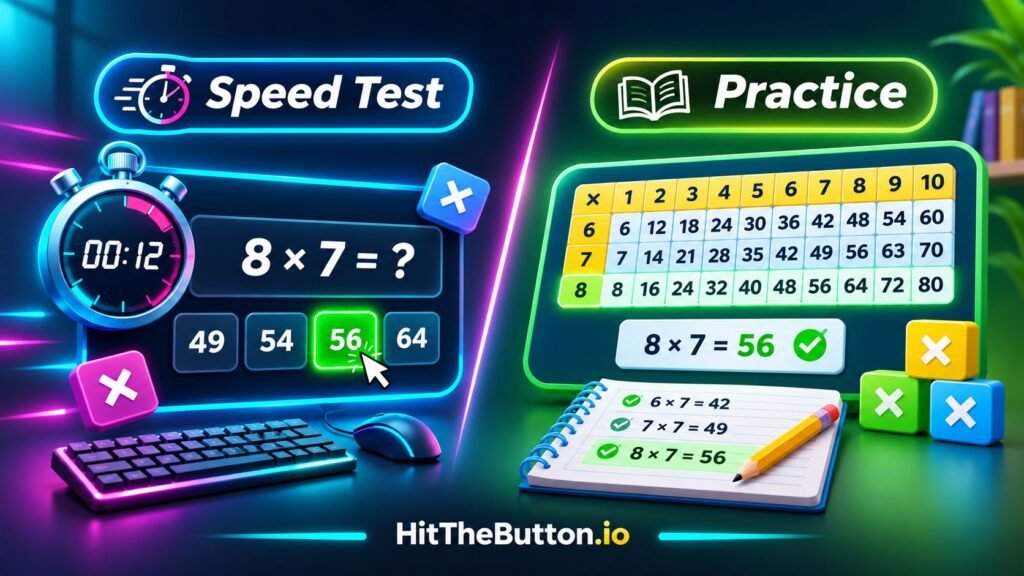
Times tables practice involves working with multiplication facts repeatedly to develop familiarity, understanding, and recall.
For example, someone learning the 7 times table might begin with 7 × 1 and gradually work through 7 × 12 before attempting questions in a random order.
Practice can involve written exercises, flashcards, interactive games, verbal questions, or mental arithmetic activities. It can be timed or untimed, depending on the learner’s needs.
Unlike a speed-focused test, times tables practice allows learners to spend additional time understanding unfamiliar calculations, exploring number patterns, and correcting mistakes.
For instance, a learner who struggles with 8 × 7 could use a familiar multiplication fact:
8 × 5 = 40
8 × 2 = 16
40 + 16 = 56
This approach demonstrates how multiplication facts relate to one another rather than relying entirely on memorization.
Multiplication Speed Test vs Times Tables Practice
Although both activities involve multiplication, they differ in their structure, objectives, and methods of evaluating performance.
| Feature | Multiplication Speed Test | Times Tables Practice |
|---|---|---|
| Main purpose | Assess timed performance | Develop multiplication knowledge |
| Time limit | Usually timed | Timed or untimed |
| Primary focus | Speed and accuracy | Understanding, accuracy, and recall |
| Difficulty | Fixed or progressively increasing | Adjustable to learning needs |
| Repetition | Depends on question generation | Often focused and structured |
| Scoring | Usually based on correct answers or completion time | May not require a score |
| Error review | Depends on the test format | An important part of practice |
| Suitable for | Learners familiar with multiplication facts | Beginners and experienced learners |
| Progress tracking | Comparing test results | Observing accuracy and understanding |
Speed Testing vs Learning
A multiplication speed test provides a snapshot of how someone performs during a particular session. It can reveal which questions are answered quickly and which may require more thinking time, provided the test records those details.
Times tables practice provides opportunities to address those difficulties. Learners can revisit unfamiliar multiplication facts, explore calculation strategies, and repeat challenging questions without necessarily working against a timer.
The distinction is not absolute. A timed game can provide practice, and an untimed exercise can assess knowledge. What matters is how the activity is structured and used.
Accuracy vs Speed
Answering quickly is useful when the answer is correct. Speed alone does not demonstrate mathematical understanding.
Mathematical fluency involves accurate, efficient, and flexible use of mathematical procedures. Timed activities capture only part of that broader ability. nctm.org+1
For beginners, developing accurate calculation methods is generally a more appropriate starting point than trying to answer every question immediately.
What Does a Multiplication Speed Test Measure?
Understanding the meaning of a test result helps prevent misleading comparisons.
A multiplication speed test primarily measures observable performance under its specific rules, rather than overall mathematical knowledge.
Correct Answers and Accuracy
A score based on correct answers indicates how many questions a player answered successfully during a round.
Accuracy measures the proportion of attempted questions answered correctly.
Consider these two hypothetical results from a 60-second challenge:
| Measurement | Player A | Player B |
|---|---|---|
| Questions attempted | 25 | 30 |
| Correct answers | 24 | 24 |
| Incorrect answers | 1 | 6 |
| Accuracy | 96% | 80% |
| Score | 24 | 24 |
Both players achieve the same score if each correct answer earns one point without penalties. However, Player A demonstrates greater accuracy during this example.
This illustrates why a total score does not always provide a complete picture of performance.
Response Speed and Multiplication Recall
Some tests record how long players take to answer individual questions. Others measure only the number of correct answers within a fixed duration.
Quick responses may reflect familiarity with multiplication facts, efficient mental calculation, or recognition of the correct answer among multiple-choice options.
A timed result cannot independently establish whether someone recalled an answer from memory, calculated it using a strategy, or guessed correctly.
A multiplication speed test is not a comprehensive assessment of intelligence or mathematical ability.
Factors That Affect Speed Test Results
Multiplication speed test results can vary even when the same person completes several rounds.
Important factors include:
- Multiplication familiarity: Practising certain tables more frequently may make those questions easier to answer.
- Question difficulty: Smaller multiplication facts may require less calculation than unfamiliar combinations involving larger numbers.
- Question format: Selecting an answer from four choices differs from producing an answer independently.
- Input method: Keyboard, mouse, and touchscreen controls involve different physical actions.
- Device performance: Input latency, browser responsiveness, and screen layout may influence interaction speed.
- Testing environment: Distractions, interruptions, tiredness, and comfort with timed activities can affect performance.
- Previous experience: Familiarity with the game’s layout and controls may influence later scores.
Random question selection also introduces natural variation between attempts. Two rounds with identical time limits may contain different combinations of multiplication facts.
For more meaningful comparisons, use the same game, device, input method, and difficulty settings whenever practical.
Practical Examples of Both Approaches
Consider how a learner might work with multiplication using two different activities.
Example of a Multiplication Speed Test
Imagine a 60-second challenge presenting questions such as:
| Question | Correct answer |
|---|---|
| 6 × 7 | 42 |
| 8 × 9 | 72 |
| 12 × 4 | 48 |
| 7 × 8 | 56 |
| 9 × 11 | 99 |
The learner attempts as many questions as possible before the timer expires. The final score represents the number of correct answers if the game awards one point per correct response.
The activity provides a convenient way to observe timed performance.
Example of Times Tables Practice
A learner who frequently struggles with the 7 times table could concentrate on a small group of multiplication facts.
For example, 7 × 6 equals 42, 7 × 7 equals 49, and 7 × 8 equals 56.
Instead of rushing, the learner can explore how each result increases by seven and use familiar answers to calculate unfamiliar ones.
Once those facts become more familiar, the questions can be presented in a random order to practise recalling them independently.
This approach targets specific learning needs rather than maximizing a timed score.
Which Approach Should You Choose?
The most suitable activity depends on your current multiplication knowledge and what you want to accomplish.
Times tables practice is particularly appropriate when you are learning unfamiliar facts, frequently making calculation errors, or developing an understanding of multiplication patterns.
A multiplication speed test may be more appropriate when you already know many multiplication facts and want to challenge your recall under timed conditions.
Children learning multiplication should not feel required to achieve a particular speed before they understand the calculations. Students and adults who enjoy timed challenges can use them as optional practice activities.
There is also an important distinction between timed practice and formal assessment. Short timed activities involving previously learned material can be useful within a broader learning routine, but they should not replace mathematical explanation, reasoning, or other forms of assessment. Institute of Education Sciences+2
How to Combine Speed Tests and Times Tables Practice
Combining focused practice with occasional timed challenges offers a practical way to work on both multiplication knowledge and performance.
A simple routine could involve the following steps:
- Review multiplication facts that you find difficult.
- Practise individual times tables without a timer.
- Attempt mixed multiplication questions.
- Complete a short multiplication speed test.
- Review any mistakes or unfamiliar calculations.
- Return to focused practice before attempting another timed round.
For example, if you repeatedly struggle with 7 × 8 during a speed challenge, spend some time reviewing the relationship between 7 × 7, 7 × 8, and 7 × 9.
The next timed attempt provides another opportunity to use that knowledge.
Rather than comparing yourself with other players, consider tracking your own performance across comparable sessions.
Common Misunderstandings
One common misunderstanding is that a higher multiplication speed score proves greater mathematical ability. A timed game measures a limited set of arithmetic skills and cannot assess every aspect of mathematics.
Another misconception is that memorizing times tables automatically means understanding multiplication. Knowing that 6 × 8 equals 48 is useful, but understanding why that result is correct and when to apply multiplication involves additional knowledge.
It is also inaccurate to assume that every multiplication speed test produces comparable scores. Differences in duration, question difficulty, scoring, and answer formats can make direct comparisons misleading.
Finally, timed challenges are not necessarily the best starting point for every learner. Some people may find it easier to explore unfamiliar calculations without time pressure.
Related Math Games on HitTheButton.io
Multiplication Speed Test Online
The Multiplication Speed Test Online offers a way to practise multiplication under timed conditions. Players can use it as a personal challenge while working on accurate and efficient mental calculations.
Times Tables Speed Challenge
The Times Tables Speed Challenge combines multiplication practice with a 60-second countdown and progressive difficulty.
Players select from four answer choices, earn one point for each correct answer, and unlock harder questions after every five correct answers until reaching Level 6.
The game includes multiplication facts up to 12 × 12, immediate corrective feedback, keyboard and touchscreen controls, and personal best tracking.
Its progressive difficulty makes it a useful example of how timed testing and multiplication practice can overlap. However, because the questions become harder as the score increases, the final score reflects performance across changing difficulty levels.
Frequently Asked Questions
Multiplication speed test vs times tables practice: Which is better for beginners?
Times tables practice is generally a more suitable starting point for beginners because it allows them to explore multiplication facts, understand calculation methods, and correct mistakes without necessarily facing time pressure.
Is multiplication speed more important than accuracy?
No. Accurate answers are essential to successful multiplication. Speed becomes a useful additional goal once learners can solve the relevant calculations reliably.
Can timed multiplication games replace regular practice?
Timed games can supplement regular practice, but they should not replace activities that develop multiplication understanding, calculation strategies, and the ability to apply multiplication in different situations.
Why does my multiplication speed test score keep changing?
Scores can vary because of question difficulty, random question selection, concentration, familiarity with the game, and input methods. A single result should not be treated as a definitive measure of progress.
How can I track my multiplication performance?
Record results from comparable sessions using the same game, time limit, and controls. Where available, review both accuracy and correct-answer totals. Look at patterns across several attempts rather than relying exclusively on your highest score.
Final Summary
The key difference when comparing a multiplication speed test vs times tables practice is that speed tests evaluate timed performance, while practice provides opportunities to develop multiplication knowledge, accuracy, and recall.
Both approaches can complement each other. Begin by understanding multiplication facts, practise unfamiliar calculations, and introduce timed challenges when you feel comfortable. Focus on accurate answers, meaningful practice, and personal progress rather than speed alone.
