Free Online Game
What Does a Memory Test Score Mean? A Clear Explanation
A memory test score shows how you performed on a particular memory task under a particular set of rules. If you are asking what does a memory test score mean, the most important point is that the number does not have one universal meaning. Its interpretation depends on what the test asks you to remember, how it calculates the result, whether it uses reference data, and the conditions under which you completed it.
In a browser memory game, a score might represent correct answers, sequences completed, rounds reached, mistakes made, or points awarded through a game-specific formula. A professionally administered cognitive assessment works differently and may compare performance with standardized reference data.
Understanding that distinction helps you read a score sensibly without assuming that one number describes your overall memory, intelligence, or health.
What Does a Memory Test Score Mean?
A memory test score is a measurement of performance on the specific task you completed.
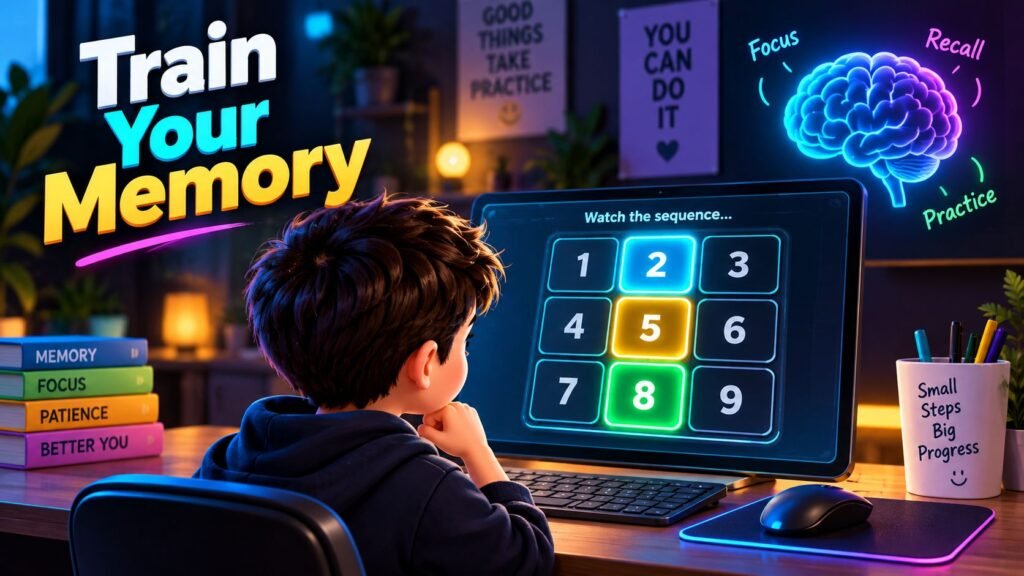
Suppose a game briefly shows a sequence of numbered tiles and then asks you to reproduce them in the same order. Your result might depend on how many tiles you remembered correctly, how long the sequence became, how many rounds you completed, and how many mistakes you made.
Another memory task might show words and ask you to recall them later. A different test might ask you to recognize previously displayed pictures. Although all three involve memory, their scores are measuring performance on different tasks.
That is why a score such as 50, 100, or 500 means very little without knowing the scoring rules.
For a recreational online memory game, the most useful interpretation is often straightforward: the score tells you how well you performed according to that game’s rules. It can be useful for comparing your own attempts within the same game, but it should not automatically be treated as a clinical result.
How Memory Scores Work
Not every memory test calculates scores in the same way. Understanding the type of result you are looking at is the first step toward interpreting it correctly.
Raw Scores
A raw score is the result produced directly from your responses before any further statistical interpretation.
Depending on the test, it might be:
- 12 correctly remembered items
- 7 completed sequences
- 3 mistakes
- 80 percent accuracy
- a longest sequence of 9 items
Raw results describe what happened during the task. By themselves, however, they do not tell you whether a result is unusually high, low, or typical for a particular population.
A score of eight remembered items could represent strong performance on one task and ordinary performance on another because the tests may differ greatly in difficulty.
Standardized Scores
Some formal cognitive assessments go beyond raw results. They use standardized administration procedures and reference data developed for that particular assessment.
A raw result may be converted into another type of score that indicates how performance compares with an appropriate reference group. Depending on the assessment, interpretation can take account of factors such as age and other characteristics specified by that test’s scoring system.
This process is very different from simply receiving points in an online game.
A standardized score only has meaning within the framework of the assessment that produced it. You should not take a standardized number from one memory test and directly compare it with a number from an unrelated test.
Game Scores
Online memory games frequently use custom scoring formulas designed to make gameplay engaging.
For example, a sequence game may award points for each correct selection and additional points when a complete round is finished. It may also increase difficulty by adding another item to the sequence.
In that situation, a higher score generally means that you performed better according to those particular rules. It does not necessarily mean that you have a particular level of memory ability outside the game.
Important Measurements Behind a Score
A total score can sometimes hide useful details. Looking at the individual parts of your performance can give you a clearer picture of what happened during a game or test.
Accuracy
Accuracy describes how often your responses were correct.
Imagine two players who reach a similar round. One completes most sequences without errors, while another makes several mistakes but has enough attempts to continue. Their final point totals may be close even though their paths through the game were different.
For practice purposes, tracking accuracy alongside the total score can therefore be useful.
Sequence Length
Sequence length matters in games where you must remember information in the correct order.
A player who correctly reproduces four items is completing a different challenge from one who successfully reproduces eight. As the sequence grows, there is simply more information to keep track of during the task.
Some memory games use the longest completed sequence as a result. Others translate sequence performance into points or rounds.
Errors and Lives
Mistakes may also influence the result.
In a game that gives players several lives, one incorrect selection may remove a life without ending the session. Lives are therefore part of the game’s difficulty and scoring structure.
A life counter is a gameplay mechanic, not a clinical measure of memory.
This distinction is particularly important when interpreting recreational browser games.
Response Speed
Some memory tasks measure response time, but others do not.
A timed test may reward fast answers or record how long responses take. An untimed sequence game may instead emphasize entering the correct pattern without requiring a rapid response.
Because of this difference, you should not assume that faster always means better. Speed only matters when it is genuinely part of the test’s design.
Why Scores Differ Between Tests
Two games can both be described as memory tests while producing completely different scores.
One may involve numbers. Another may use visual positions. Another might ask you to remember words or recognize previously presented objects.
The presentation can also differ. Information might appear for half a second, several seconds, or until the player chooses to continue. Some games provide one attempt, while others provide several lives.
Scoring formulas vary just as much. One game could award ten points per correct response, while another might display only the maximum round completed.
For that reason, scores from different memory tests usually cannot be compared directly unless the tests were specifically designed to use a comparable scoring system.
If you scored 200 in one browser game and 80 in another, the first number does not automatically represent better memory performance.
Factors That Can Affect Your Result
A memory-game score can change from one attempt to another even when the same person plays the same game.
Attention is one obvious factor. Missing a single displayed item because you looked away can affect the entire sequence.
Experience also matters. During your first attempt, part of your attention may be spent understanding the controls. After several attempts, you already know when to watch and when to respond.
The testing environment can make a difference too. Noise, notifications, conversations, or other distractions may interfere with your ability to concentrate on a short sequence.
The device can influence certain tasks as well. A keyboard may feel faster for entering numbers, while a touchscreen may make spatial patterns easier to follow for another player. Screen size can affect how comfortably you view the entire game board.
Browser or device performance becomes especially relevant when a task depends heavily on precise timing. Input delay and inconsistent animation can make very small timing differences harder to interpret.
Rest between attempts can also matter. Repeating the same demanding task many times without a break may produce different results from playing a few focused rounds.
These factors are reasons to be cautious about drawing broad conclusions from a single number.
An Example of Reading a Game Score
Consider a simple sequence memory game.
On your first session, imagine that you reach Round 5 before losing all available lives. Later, under similar conditions, you reach Round 7 and complete longer sequences with fewer mistakes.
A reasonable interpretation would be that you performed better on the later attempt at that particular game.
It could reflect greater familiarity with the rules, better concentration during that session, more effective grouping of the sequence, normal variation, or a combination of these factors.
What you should not conclude is that the second result proves your overall memory has improved by a specific amount. A browser game usually does not provide enough information to support that kind of claim.
Personal results are most useful when compared within the same game, using similar settings and conditions.
What a Score Does Not Tell You
One of the most important parts of understanding what a memory test score means is knowing its limitations.
A recreational memory-game result does not automatically tell you:
- your intelligence
- your overall cognitive ability
- whether you have a memory disorder
- whether you have an attention-related condition
- how you will perform on unrelated learning tasks
- whether your memory is clinically normal or abnormal
Memory is not a single task. Remembering a short visual sequence differs from remembering information after a long delay, recognizing previously seen items, recalling a story, or remembering something you planned to do.
Clinical interpretation is also broader than looking at one isolated score. Appropriate professional assessment considers the specific test, standardized procedures, relevant reference data, the person’s circumstances, and often performance across multiple measures.
An online game score should not be used as a diagnosis.
If someone has concerns about noticeable or persistent changes in memory that affect everyday life, a recreational browser test is not a substitute for discussing those concerns with an appropriate healthcare professional.
Common Score Misunderstandings
A common mistake is assuming that every memory score follows the same scale.
There is no universal rule saying that a score of 100 is good, average, or poor. In one game, 100 may be achievable after a few correct actions. In another assessment, the same number could come from an entirely different scoring method.
Another misunderstanding is treating a personal best as a standardized result. A personal best simply shows your highest recorded performance according to that game’s scoring system.
Players also sometimes focus only on the total points. In a sequence game, reaching a longer pattern, maintaining accuracy, and reducing mistakes may provide more useful gameplay feedback than the point number alone.
Finally, one unusually low attempt should not be overinterpreted. Individual performance naturally varies, and distractions, unfamiliar controls, or a simple mistake can affect the result.
Testing Conditions Matter
If you want to compare your own attempts more fairly, try to keep the conditions reasonably similar.
Use the same game and difficulty settings. If practical, use the same device and input method. Make sure you understand the controls before treating a score as a meaningful personal comparison.
Reducing distractions can also help. A sequence task depends on noticing information as it appears, so looking at another screen or checking a notification can easily interrupt the pattern.
Try not to change several conditions at once. If one attempt is completed quietly on a desktop keyboard and another is completed on a small touchscreen while distracted, differences between the scores become harder to interpret.
This does not turn a browser game into a standardized assessment. It simply creates a more consistent basis for comparing your own gameplay.
Using Scores for Memory Practice
For an online memory game, the score works best as feedback rather than a judgment.
You might track your highest completed round, longest sequence, accuracy, mistakes, or personal-best point total.
If sequences become difficult, you can experiment with grouping several items together. For example, remembering 2-5-8 and then 4-1-7 may feel more manageable than treating six numbers as completely separate pieces of information.
You can also pay attention to visual position. In a fixed 3×3 grid, some players find that remembering movement across the board complements remembering the numbers themselves.
Practice can also make you more familiar with a specific game’s mechanics and strategies. That may improve performance on the practiced task, but it should not be presented as proof of a guaranteed improvement in general memory.
Short, focused attempts with sensible breaks can also make personal comparisons easier than repeatedly playing while concentration is fading.
Online Games and Formal Assessments
Online memory games and formal cognitive assessments can look superficially similar because both may ask users to remember information. Their purposes and interpretation are different.
Browser games are generally built for entertainment, challenge, or practice. They may have points, rounds, lives, animations, difficulty progression, and personal-best records.
Formal assessments are designed around specific testing procedures. When a test is standardized, administration and scoring follow defined rules, and interpretation may involve comparison with appropriate normative information.
Even professional cognitive screening results are not interpreted in isolation without considering the purpose and limitations of the assessment.
For a HitTheButton.io memory challenge, the sensible approach is to view your result as game-specific performance unless the game explicitly states that it is a validated assessment designed for another purpose.
Related Memory Challenges
Different browser challenges can emphasize different aspects of play.
A short-term sequence game asks you to watch numbered or visual positions and reproduce their order. A visual pattern game may depend more heavily on remembering shapes or locations. Reaction games focus on responding when a target appears rather than holding a growing sequence in mind.
Trying different game types can make browser play more varied, but their results should remain separate. A reaction-time score should not be interpreted as a memory score, and a sequence-game score should not be treated as equivalent to a word-recall result.
Knowing exactly what each game measures within its own rules makes the numbers much easier to understand.
Frequently Asked Questions
What does a memory test score mean?
A memory test score describes your performance on a specific memory task. Its meaning depends on the test’s rules, difficulty, scoring method, and whether it uses standardized reference data. A browser-game score usually represents game performance rather than a clinical measurement.
What is considered a good memory test score?
There is no universal good score for all memory tests. You need to know the scoring system of the particular test. In an online game, your previous results can provide a useful personal comparison. Formal assessments require interpretation according to their own scoring standards.
Can I compare two different memory test scores?
Usually not directly. Tests can differ in content, timing, difficulty, number of attempts, scoring formulas, and purpose. Comparing scores is most meaningful when they come from the same test administered under reasonably similar conditions.
Does a low online memory score mean I have poor memory?
No. One recreational game result cannot determine your overall memory ability or diagnose a memory problem. Attention, unfamiliar controls, distractions, task difficulty, and normal variation can all influence an individual attempt.
Can practising a memory game increase my score?
It can help you become more familiar with the particular game’s rules, controls, patterns, and strategies, which may lead to better performance on that task. That should not be interpreted as guaranteed improvement in general memory or cognitive ability.
Final Summary
So, what does a memory test score mean? It means whatever the specific test’s scoring system was designed to measure. In a browser memory game, that may be correct sequences, rounds, accuracy, mistakes, or accumulated points. In a standardized assessment, interpretation may additionally involve carefully developed reference data and defined testing procedures.
For online games, the most practical use of a score is to understand your performance within that particular challenge and compare similar attempts over time. Look at the rules, accuracy, sequence difficulty, and testing conditions rather than treating one number as a universal measurement of memory. Most importantly, remember that a recreational game score is useful for practice and entertainment, not as a medical diagnosis or a complete measure of cognitive ability.